Bad Blintz rat-pit rescue
The Amazing Maurice and His Educated RodentsThe Bad Blintz rat-pit rescue is both a physical escape and a test of what the rats have become: Hamnpork is pulled from a pit where rats are set against a terrier, while Darktan confronts the dog and gets clear of the crowd. The rescue reveals the cruelty concealed by the rat-catchers’ entertainment and makes the difference between panicked numbers and purposeful cooperation impossible to ignore.
The pit and its spectacle
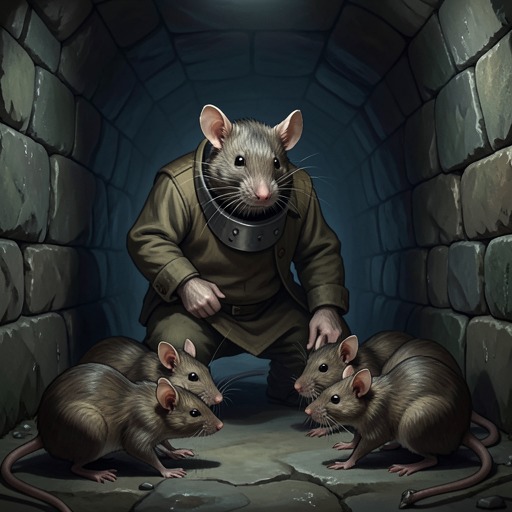
The rescue takes place within a human pastime called rat-coursing. Maurice explains that rat-catchers bring live rats to a ring and release them among terriers. The rats do not confront the dogs as a coordinated group; crowded together and overwhelmed by fear, they run in circles. Darktan initially struggles to understand why the rats do not fight back. Maurice answers by distinguishing a thinking, brave rat from a terrified mass: when many rats panic together, the crowd behaves like one large, mindless animal. The distinction anticipates the central problem of the rescue. The threat is not only the terrier, but the fear that keeps the rats from using their individual intelligence together.
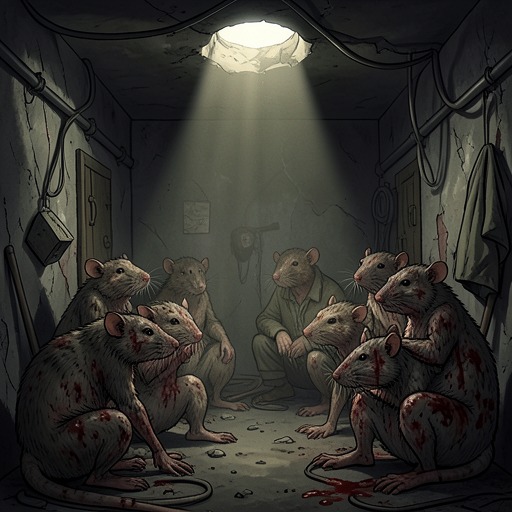
From a beam above the pit, the Changelings see how the spectacle works. A rat-catcher empties a sack into the ring, and the rats scurry in search of somewhere to hide. A terrier is then dropped among them as the human crowd cheers. The scene makes the audience part of the danger: the rats below are trapped in a public entertainment whose human spectators treat their terror as amusement. When Hamnpork is carried into the pit, the threat becomes personal to the Clan. He is tipped from a sack into the ring among the struggling rats, and the crowd’s roar accompanies his arrival.
Hamnpork’s rescue
The terrier drives the rats into a stampede. Sardines then descends on a line, with the elastic rope trailing behind him. He reaches Hamnpork and holds on to him; after the stretched bands spring back, the two rats are pulled up and left bouncing beyond the dog’s reach. The rescue depends on a device and a precise act of trust: Sardines must reach Hamnpork in the middle of the panic, and Hamnpork must be carried out by the elastic line rather than trying to fight his way through the pit alone.
The escape does not immediately end the danger. Darktan leaps down toward the terrier while the crowd watches. The move draws the dog’s attention away from the rats suspended above the pit and gives Darktan a chance to turn the animal’s pursuit against it. He attacks, then uses the dog’s movement to climb across its back and leap over the wall. On the other side, people try to stamp on him, but their crowded efforts impede one another and Darktan gets away. Other dogs break loose and pursue him, so his escape is not a safe retreat; it is a narrow passage out of the ring and through the surrounding crowd.
From panic to coordinated action
The rescue dramatizes the contrast Maurice has described between individual courage and collective panic. In the pit, rats scatter while the terrier picks them off; above it, Sardines and Darktan act with different but complementary purposes. Sardines secures Hamnpork’s escape, while Darktan diverts the dog and finds a way out. The operation is not a victory won by strength alone. It depends on timing, a workable tool, and each rat taking a role that helps the others.
That contrast recurs as the Clan faces further dangers. When fear later spreads among the rats, some run past Peaches and Dangerous Beans in such a state that they have forgotten how to speak. Darktan, now addressing frightened young rats, recasts the danger as a test of their capacity to think and stand together. The rescue at the pit provides a concrete counter-image to that collapse: rather than treating a crowd as an uncontrollable animal, the rats can act as a community with brains and a shared purpose. Later, the Clan advances in a line that closes around attackers and then divides to pursue those who flee. The contrast is sharp: panic breaks formation, while cooperation gives the rats tactical force.
Consequences and significance
The rescue does not itself settle the conflict between the rats and the people of Bad Blintz. It does, however, make the rat-catchers’ practices visible to the Clan and to the reader: the rat-catchers are not simply responding to a nuisance but bringing live rats to a pit for public entertainment. The sequence also gives Darktan’s leadership a defining demonstration. He risks himself to protect Hamnpork, confronts the terrier, and escapes without abandoning the larger struggle.
The book’s later resolution turns away from the same logic of threat and retaliation that governs the pit. When the Mayor asks why the rats did not poison wells or set houses on fire, Darktan answers that such destruction would not resolve the problem; eventually the rats would still have to speak with humans. The resulting agreement is treated as work requiring a contract and a committee, not as a happy ending achieved by a smile alone. Set against the ring, where people cheer while frightened rats run for shelter, that outcome gives the rescue a larger significance: survival begins with getting one another out of immediate danger, but lasting change requires a different relationship between the groups.